AI Security
An operating model and reference architecture for deploying AI in regulated companies: risk tiers, embedded SDLC controls, and an authorization layer for agents, tools, data and models.
Problem
Most AI programs stall between the demo and the audit. The model works, then security, legal and risk ask how it is governed, who the agent is acting as, and where the data went. The answers rarely fit into a control framework the organization already runs.
At the same time, agents are starting to call APIs, read data and take action on their own. Identity models built around human users and service accounts do not describe what an agent is allowed to do, on whose behalf, for how long.
Approach
- 01
Split the problem in two. One half is governance: a risk-tiered operating model that says what controls travel with each AI deployment, written in the language of the people who approve production use.
- 02
The other half is identity: a reference architecture for authorizing AI execution chains. Every agent, tool, data source and model gets an identity, a scope and a policy, enforced at runtime rather than reviewed after the fact.
- 03
Map both halves onto frameworks the organization already answers to (NIST AI RMF, the EU AI Act, SOC 2, ISO 27001) so that nothing new has to be invented for the auditor.
- 04
Keep the controls light enough that engineers will use them: embedded in the SDLC, instrumented by default, with the audit trail produced as a side effect of the work rather than a separate deliverable.
Architecture
Governance sets the tier and the controls; the authorization layer enforces them on every call from a user or agent to a tool, a data source or a model, and writes the audit record.
Built with
- NIST AI RMF
- EU AI Act
- SOC 2
- ISO 27001
- AWS
- Amazon Bedrock Guardrails
- Cedar policies
- Secure RAG
Outcome
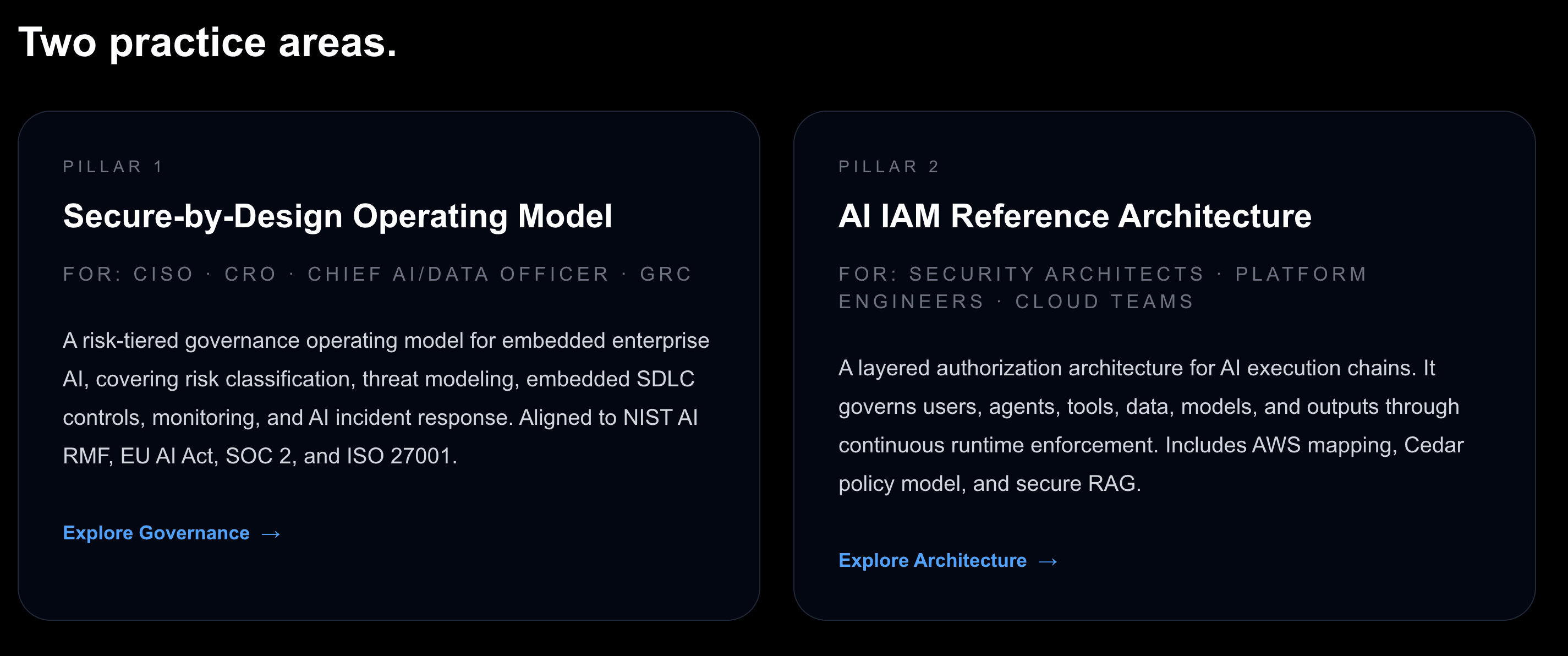
A two-pillar practice: a secure-by-design operating model for CISOs, CROs and GRC teams, and an AI IAM reference architecture for security architects and platform engineers.
The writing and reference material live at adamfade.com and are the basis of the consulting offers on this site.
Decisions
Runtime enforcement over pre-deployment review alone
because agents change what they do between reviews; the policy has to be checked on each call.
Existing frameworks as the spine over a new AI control catalog
because the audit committee already knows how to read NIST and ISO; a new catalog is one more thing to defend.
Nartis
An AI-native platform for HEDIS and CMS Star Ratings: clinical data into a governed warehouse, measure logic that is transparent and auditable, results that quality leaders can act on. Designed and prototyped.